
Featured Topics

Hide Low-Voltage Landscape Lighting Wires Without Spoiling Your Garden
Many Australian homeowners invest in low-voltage landscape lighting to enjoy their gardens after dusk, yet few anticipate how a tangle of cables can undo the careful planting work they have put in. A single black cable draped across pale gravel or peeking out of a garden bed pulls the eye away from a beautifully lit tree or pathway.
The challenge becomes especially obvious in established gardens across Sydney's northern beaches or the leafy eastern suburbs of Melbourne, where mature plantings make retrofit lighting more complex than laying fresh cable on bare soil. Older homes in Adelaide and Brisbane often share the same problem, with patios added long after the original garden was planted.
With products available through local chains such as Bunnings and Mitre 10, and through retailers like Amazon and Home Depot, Australians have plenty of fixture options from brands like Philips and InnoGear. The aesthetic problem shifts from choosing the right fitting to making sure the cable disappears into the landscape rather than running across it.
A few techniques borrowed from professional installers can keep low-voltage cabling out of sight, protected from harsh Australian sun, and safe from curious pets, whipper-snippers, and lawnmowers in equal measure.
Map the route before you trench
A good outcome begins with a slow walk around the garden at dusk, holding a torch to identify which trees, walls, or sculptural elements deserve light. Mark the proposed fixture spots with small stakes, then trace the simplest path back to the transformer, usually mounted on an exterior wall or in the garage. Avoid crossing high-traffic lawn areas where the cable will eventually be cut by mower blades, and route around root zones of natives such as lomandra and banksia.
Sketching the plan on paper makes it easier to measure total cable length and avoid underbuying. Allowing roughly ten per cent extra for slack saves an urgent dash back to the hardware store mid-install. For inspiration on lighting tree canopies, the tree highlighting guide offers Australian-friendly approaches worth borrowing.
Most low-voltage systems use 12V or 24V cabling, which in Australia does not require a licensed electrician to install when the transformer plugs into a standard outdoor power point protected by a residual current device. Always verify the latest wiring rules under AS/NZS 3000 before starting any work.
Bury cable below the soil line
The cleanest result comes from burying the cable, even though it sits only a few centimetres underground. A common method is to slice the lawn with a flat spade, push the cable into the gap, and firm the turf back over the top. In garden beds, a narrow trench roughly 100 to 150 mm deep is enough for low-voltage cable, which carries less current than mains wiring and poses no electrocution risk if a spade strikes it later.
Keeping the cable out of the reach of regular mower blades matters more than deep burial, so plan the cutting path before laying anything. Where the cable must cross a lawn, run it through a short length of PVC conduit buried deeper than the lowest mower setting, then backfill and topdress with grass seed.
Avoid running low-voltage cable parallel to irrigation lines within the same trench, because a leaking poly fitting can stay wet against insulation for years. A separation of at least 100 mm helps both systems stay serviceable.
Blend surface runs into the landscape
Where burial is not practical, such as across rocky ground in a Perth hills garden or over exposed tree roots in a Brisbane backyard, the cable can be disguised rather than hidden. Press it firmly into the soil along the edge of a garden bed, cover it with 20 mm of mulch or bark, and the dark insulation vanishes against dark soil.
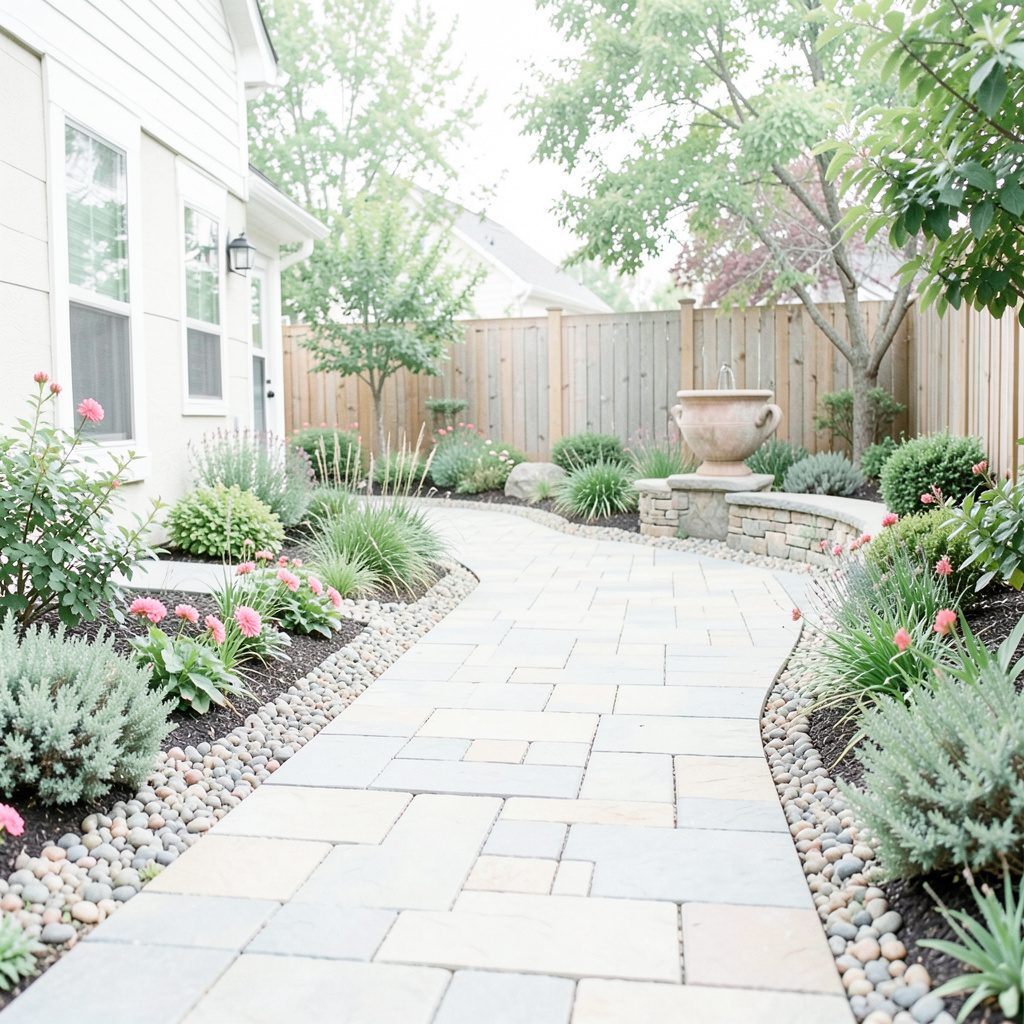
Over gravel pathways, the same approach works if the gravel is dark in colour. Lay the cable in a shallow groove pressed into the sub-base, then settle the gravel back over the top. Decorative stone from coastal suppliers in places like Coffs Harbour often comes in tones that hide black insulation almost as well as mulch does. For a more deliberate look, the gallery of completed designs shows how runs can follow the natural curve of a path without breaking the visual line.
On timber decking, run the cable along the joist line and secure it with stainless-steel cable clips. Most of the clip disappears into the shadow beneath the boards, leaving only the light fitting itself visible.
Use above-ground covers where burial is not practical
Some surfaces simply will not allow burial. Exposed aggregate concrete, heritage pavers, and steep sandstone steps common in Sydney's harbourside gardens leave no room to trench. In these spots, low-profile cable covers painted to match the surface do the job without becoming an eyesore.
Metal conduit painted matte black or stone grey sits flush against a wall and reads as a deliberate architectural detail. Plastic cord protectors, often sold in the lighting aisle of Bunnings, are cheaper but stand out more unless tucked behind a planter or hedge. For junction boxes and transformer housings, a few craft projects can turn functional boxes into garden features. Some homeowners embellish unavoidable connection points, drawing inspiration from community groups such as Purple Stitch Project for decorative wraps and covers that disappear into the planting.
When using any above-ground cover outdoors in Australia, choose UV-stabilised materials. Standard PVC grows brittle after two or three summers of intense sun and eventually cracks, exposing the cable beneath.
Maintain hidden wires through every Australian season
Concealment is not a one-off task. Soil settles, mulch breaks down, and curious wildlife shifts the surface. Twice a year, walk the route after a heavy downpour and look for any cable that has surfaced or become taut.
Coastal gardens face extra challenges from salt-laden air, which degrades plastic clips and conduit fittings faster than inland installations. Stainless-steel fixings cost a little more but last through the salt spray along the Mornington Peninsula or the Sunshine Coast. Inland, high UV levels crack older PVC insulation, so a five-yearly check of all exposed runs is a sensible habit.
Replace any sections that have become brittle before they fail, and keep a small reel of spare cable plus a handful of gel-filled connectors in the shed. With seasonal care, a low-voltage lighting system stays as quiet in the landscape as it was on the day it was first switched on. For ongoing ideas and inspiration, the homepage collection gathers a wide range of practical guides in one place.
Practical tips for a clean wire install
- Choose dark-coloured cable for garden beds and mulched areas; even when it surfaces briefly, it disappears against dark soil.
- Run cable along the back edge of a garden bed rather than its centre, where planting activity tends to disturb it.
- Use gel-filled direct-burial connectors rather than twisting wires together and wrapping them in electrical tape.
- Leave a small loop of slack at each fixture, so the connection can be lifted out for servicing without digging up the run.
- Mark the cable route on a simple plan kept with the installation manual, so future plantings or irrigation work does not damage the line.
- Where the cable crosses a lawn, sleeve it in conduit buried slightly deeper than the mower's lowest cut.
- Keep low-voltage cable at least 300 mm away from mains-voltage wiring to avoid induced voltage on long parallel runs.
After the dust has settled and the lights come on, the real test of any concealment strategy is whether a visitor notices the cable at all. When the only things visible after dusk are the warm beam on a sandstone wall and the soft glow along a garden path, the wiring has done its job properly. A clean install rewards the eye today and saves hours of maintenance through the next decade of Australian summers, especially when a simple seasonal inspection becomes part of the garden routine each autumn and spring.